
Create a real-time currency exchange rate alert.

How Much Is a Wire Transfer in Canada? Fees & Costs Explained

You’d think a wire transfer would come with a simple price tag. Instead, you see a mix of wire fees, exchange rate markups, and vague “additional charges” that only show up after the money leaves your bank account.

That confusion is exactly what people encounter when they ask, “How much is a wire transfer?” and the answer rarely comes straight.

If you send money through a Canadian financial institution, especially across borders, the final cost can vary depending on the bank, the currency, the destination, and the method of payment. An international wire transfer in United States dollars (USD) can cost far more than a domestic transfer in Canadian dollars (CAD), and most banks don’t volunteer the full breakdown.

This guide strips away the guesswork. You’ll see what Canadian banks actually charge, where the hidden costs live, and how to avoid paying more than you need to move your money.

What does a wire transfer actually cost in Canada?
The true cost comes from three separate layers, including your bank’s service fee, possible intermediary charges, and foreign exchange markups if currency conversion is involved. Each one chips away at the amount sent from your bank account in the following ways.

Standard outgoing wire fees

Canadian banks charge different wire transfer fees depending on where the money goes and how you send it.

For a domestic wire transfer in CAD, banks typically charge between $15 and $30. These payments usually settle within one to two business days and move directly between Canadian financial institutions.

An international wire transfer costs more. Outgoing international wires often range from $30 to $80, depending on the bank, destination, and whether you send the transfer in-branch, through online banking, or via mobile banking. Sending USD or another foreign currency usually pushes fees higher, especially when the recipient’s bank sits outside Canada.

These are just the up-front service fees. They don’t reflect what happens to your money once it leaves your bank.

Intermediary bank fees

Many international wire transfers don’t move directly from sender to recipient. Instead, they pass through one or more intermediary banks before reaching the recipient’s bank account.

Each intermediary bank can deduct its own fee, often $10 to $25, from the transfer. These charges don’t appear on your receipt, and your bank rarely controls them. The result is a smaller deposit landing in the recipient’s account, even if you paid a flat wire fee up front.

This is common with cross-border transfers that rely on SWIFT codes, IBANs, or routing through major international banks. It’s one of the most frustrating parts of international money transfer pricing because neither the sender nor the recipient sees the full fee structure in advance.

FX margin markups

If your wire transfer involves currency conversion, exchange rates quietly become the most expensive part of the transaction.

Banks typically apply a foreign exchange margin of 2% to 4% on top of the mid-market rate. That markup applies whether you’re sending US dollars, euros, or another foreign currency. On a $10,000 transfer, a 3% FX margin means $300 disappears before the money even reaches the recipient.

Banks rarely describe this as a fee. It shows up as a less favourable rate compared to a real-time currency converter, making it harder to spot.

When you combine service fees, intermediary charges, and FX markups, the final answer to how much a wire transfer is often ends up far higher than expected, especially for international payments. Understanding each layer puts you in a better position to reduce costs and keep more of your money working for you.

How much do Canadian banks charge for wire transfers?

If you ask your bank how much a wire transfer is, you’ll usually get a single number. What you won’t get is the full cost picture. Canadian banks publish base wire fees, but the final amount sent and received often tells a different story once service fees, bank fees, and exchange rate markups come into play.
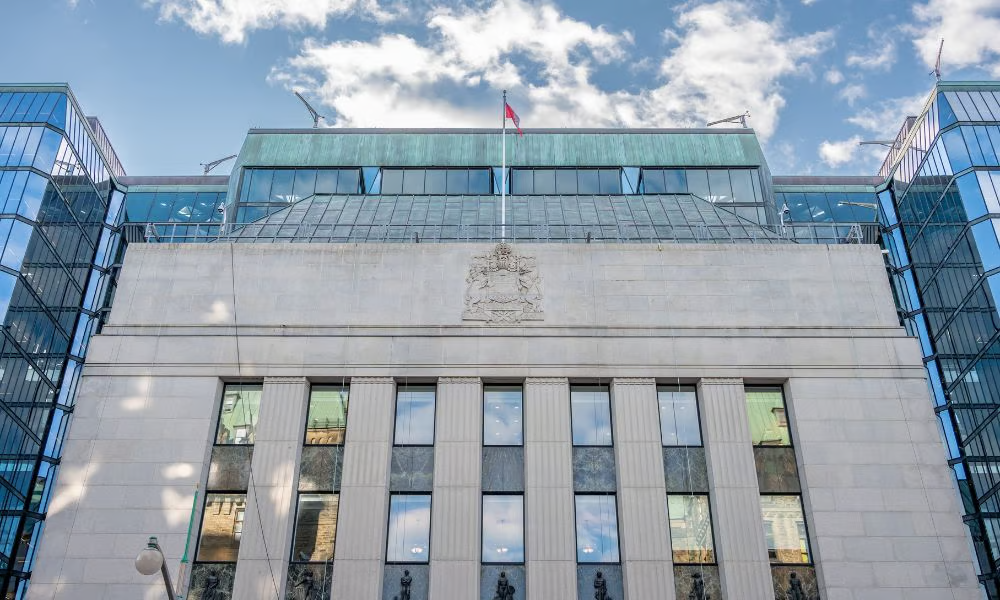
Stone and glass government building with a Canadian flag, representing Canada’s central banking and financial system

Typical fee ranges across major Canadian banks

Most large Canadian banks follow a similar pricing structure for outgoing wire transfers.

For domestic wire transfers in Canadian dollars (CAD), you can expect service fees between $15 and $30. These payments usually clear quickly, with wire transfer timeframes in Canada landing within one to two business days.

International wire transfers cost more. Outgoing international wires typically range from $30 to $80, depending on the financial institution and whether you send the payment in-branch or through online banking. Incoming wire transfers may also carry fees, often $15 to $20, deducted before funds reach the recipient’s account.

Banks like RBC, CIBC, and Scotiabank publish these wire fees openly. What they don’t highlight is how often the transfer also triggers FX margins, intermediary bank deductions, and additional charges tied to currency conversion.

Why businesses get surprised by the final amounts received

The shock usually comes from what isn’t listed on the fee page.

When a wire involves foreign currency, banks apply an exchange rate that includes a markup above the market rate. That margin can quietly exceed the visible wire fee itself. Add intermediary banks to the route, and each one may deduct its own transaction fees before the money reaches the recipient’s bank.

This is where many businesses lose visibility. The sender sees one fee. The recipient sees less money arrive. Somewhere in between, FX markups and third-party bank charges reduce the transfer value, without a clear breakdown.

That’s why many businesses start looking beyond traditional banks for international money transfer needs. Providers that focus on transparent pricing and sharper currency exchange Canada rates, like Canada-based KnightsbridgeFX, remove the guesswork. You see the rate, you see the cost, and you know exactly how much lands in the recipient account, no surprises after the transfer is complete.

The hidden cost that matters most: FX markups, not wire fees

Flat wire fees grab attention because they’re easy to see. The higher cost sits quietly in the exchange rate. That’s why asking how much a wire transfer is without looking at FX margins almost always leads to the wrong conclusion.

Let’s elaborate.

How a 2%–3% FX markup impacts business transactions

A 2%–3% FX markup sounds small until you apply it to real numbers. On a $25,000 USD payment converted to CAD, a 2.5% margin costs you $625, far more than the wire fee itself. The more you send money, the more that margin compounds.

This hits hardest when you move funds regularly between currencies. Even when you follow the same steps for how to send a wire transfer, the cost shifts every time the exchange rate does. Over a year, FX margins can quietly drain thousands from your operating budget.

Why most banks don’t disclose their real FX spread

Banks rarely label FX margins as fees. Instead, they build them into the exchange rate you’re offered. You won’t see a line item saying “FX markup.” You’ll just get a rate that’s worse than the market.

That lack of transparency makes it difficult to compare providers or forecast costs accurately. By the time you realize the impact, the transfer has already cleared, and the loss is locked in.

How KnightsbridgeFX lowers total transfer costs

KnightsbridgeFX tackles the cost that actually matters. Instead of hiding margins inside inflated exchange rates, you get access to highly competitive FX pricing with clear, up-front visibility.

You still make international wire transfer payments when needed, but without paying unnecessary FX markups. That means:

  • Sharper exchange rates on large and small transfers
  • No surprise deductions after the funds leave your account
  • Predictable costs you can plan around

When FX margins shrink, the question of how much a wire transfer is suddenly has a much better answer.

Also read: KnightsbridgeFX vs OFX Review: Which Is Best?

Wire transfer costs for businesses: What actually drives your costs up?

Wire transfers become expensive when everyday business realities collide with opaque pricing and rigid banking processes. The following is how that happens.

High-volume or frequent USD/CAD transfers

If you move funds between USD and CAD often, FX margins matter more than wire fees. Repeated conversions amplify small spreads into material losses, especially when you rely on banks that apply wide markups on every transfer.

Unpredictable timing and cash-flow issues

Wire transfers don’t always settle when you expect. Delays of one or two business days can disrupt cash flow, particularly when supplier payments or payroll depend on exact timing. Uncertainty around settlement makes planning harder and often forces you to keep excess cash on hand.

Difficulty managing multiple payables across countries

Handling payables across borders means juggling different bank accounts, currencies, and recipient requirements. Each international transfer introduces new variables, intermediary banks, currency conversion, and inconsistent transaction fees, all of which inflate costs and complexity.

Trust, compliance, and documentation challenges

Businesses also carry the burden of compliance. Missing details like an incorrect account number or bank name can delay payments or trigger additional charges. Every error risks more fees, more admin time, and strained relationships with overseas partners.

When you focus only on the posted wire fee, these drivers stay hidden. When you focus on FX margins, timing, and transparency, you gain real control over what wire transfers actually cost your business.

How to reduce the cost of international wire transfers

If you only compare posted bank wire fees, you miss the biggest savings opportunities. Reducing the real answer to how much a wire transfer is comes down to controlling FX costs, timing, and routing.

KnightsbridgeFX homepage promoting zero hidden FX fees for businesses, and USD currency exchange savings.

Compare FX providers, not just bank wire fees

Banks focus attention on flat fees because FX margins stay buried in the rate. Compare providers based on their exchange rates, not just what banks charge to send money. A tighter FX spread often saves more than eliminating a wire fee.

Use dedicated FX payment partners for high-value transfers

For larger payments, dedicated FX specialists consistently outperform banks. They price currency exchange competitively, reduce markup, and provide clearer cost visibility, especially on recurring international payments tied to contracts or suppliers.

This is where KnightsbridgeFX stands out. You get institutional-level exchange rates, transparent pricing, and no surprise deductions after funds leave your account.

Schedule transfers strategically

FX rates fluctuate throughout the day and week. Planning transfers around known payment dates, rather than reacting at the last minute, gives you more control over rates and reduces volatility-driven costs.

Minimize intermediary bank involvement

Ask providers how they route payments. Fewer intermediary banks mean fewer unexpected deductions and faster settlement. Clean routing also lowers the risk of delays tied to missing or mismatched banking details.

How FX specialists help you save on every cross-border payment

FX specialists shift the focus from transactional fees to total cost control, where real savings sit. Here’s how.

Transparent pricing with no hidden fees

FX specialists like KnightsbridgeFX quote rates clearly and explain all charges up front. You know what leaves your account and what arrives at the recipient’s bank. This eliminates guessing and reconciliation headaches.

Better exchange rates reduce total payment costs

Sharper exchange rates consistently beat bank pricing. Even small improvements compound quickly across multiple transfers, lowering your total cost far more than trimming wire fees alone.

Faster support and communication

Dedicated FX partners offer direct access to specialists who understand your transactions. When questions come up, you deal with people who know your account, not a call queue.

Secure, compliant infrastructure

FX specialists operate within strict regulatory frameworks like the Financial Consumer Agency of Canada (FCAC) or Financial Transactions and Reports Analysis Centre of Canada (FINTRAC). You get secure processing, proper documentation, and confidence that your cross-border payments meet compliance requirements.

How much could your business save?

Take a Canadian business sending funds in foreign currency several times a month. The posted wire fee might be $40. The FX markup hidden in the exchange rate can easily add hundreds more to each transfer. Over a year, that difference becomes material, especially for exporters paying overseas suppliers or importers settling invoices in USD.

Even a modest improvement in exchange rates changes the math. Tighter FX pricing means:

  • Lower effective costs on every transfer
  • More predictable cash flow across currencies
  • Fewer surprises when funds reach the recipient’s account

When you strip out inflated FX margins, wire transfer costs stop eroding your margins and start becoming manageable operating expenses.

Wire transfer fees don’t have to eat into your margins

Banks vary widely in what they charge for wire payments. Some add service fees on both outgoing and incoming transfers. Others layer on additional charges through intermediary banks. But across the board, FX markups remain the biggest cost driver and the least transparent one.

That’s where working with a dedicated FX provider makes the difference. Canada-based KnightsbridgeFX focuses on what banks don’t: competitive exchange rates, clear pricing, and no hidden fees buried in the spread. You see your rate up front, understand your costs, and know exactly what lands in the recipient’s account.

If you want a clear answer to how much a wire transfer is for your business, the next step is simple. Get a free rate quote and see how much you could save by cutting FX margins out of every cross-border payment.


Best Way to Convert CAD to USD and Save on Exchange Rates

Canadians who spend part of the year in the US know how quickly currency conversion costs add up. Rent, healthcare, groceries, and daily spending all hinge on the Canadian dollar (CAD)/United States dollar (USD) rate, and even a small shift can mean thousands of dollars over a season.

That’s why finding the best way to convert CAD to USD matters far more than convenience. Most people still rely on their Canadian bank, an ATM, or a credit card without realizing how much they lose to weak exchange rates and hidden fees.

The good news is you don’t have to accept that. This guide breaks down the most cost-effective ways to convert Canadian dollars to US dollars, shows where traditional options fall short, and explains how to lock in a better rate when you need USD the most.

What snowbirds really need when converting CAD to USD

Snowbirds face a very different reality from occasional travellers. You’re not converting a few hundred dollars for a short trip. You’re moving large sums to cover months of rent, insurance, healthcare, and everyday living in the US.

That makes Snowbirds’ currency exchange decisions far more sensitive to exchange rates, fees, and timing. The wrong choice quietly erodes your budget throughout the entire season. Let’s explain how that happens.

Larger transfers mean small rate differences cost thousands

When you convert CAD to USD in large amounts, even a fraction of a cent matters. A 1% markup on a $50,000 conversion costs you $500 instantly. Many financial institutions advertise low or “no” fees but bake their profit into weak CAD/USD exchange rates.

Most Canadian banks and financial institutions build that cost into their exchange rates through wide spreads. You never see the fee, but you pay it. FX specialists like KnightsbridgeFX price closer to the mid-market exchange rate, which limits markups and keeps more of your money in USD. For large amounts, that pricing model matters far more than a one-time transfer fee.

Seasonal timing matters

Snowbirds tend to exchange Canadian dollars at predictable times, including fall departures and spring returns. Demand spikes during these periods, and exchange rates often fluctuate. Locking in a rate when the Canadian dollar dips can dramatically increase your cost of living in USD.

A smarter approach focuses on monitoring the current rate, understanding CAD/USD trends, and choosing providers that allow you to act quickly when favourable rates appear. Timing alone can make a noticeable difference when converting CAD to USD for seasonal stays.

Convenience matters, but so does trust

Speed and simplicity matter when you’re managing finances across borders. Same-day or next-business-day money transfers reduce stress, especially when rent or healthcare payments come due.

That said, trust matters just as much. Snowbirds need providers that specialize in foreign exchange, not general-purpose banking products. Reliable customer support, transparent pricing, and secure transfers protect you from errors that banks and apps often treat as low priority.

The best way to convert CAD to USD is to do so with confidence that your money moves safely and at a fair rate.

The most common ways to convert CAD to USD

Many Snowbirds rely on familiar tools without realizing how poorly those options perform for repeated, high-value CAD/USD conversions. Understanding these limitations explains why FX specialists consistently deliver better results.

1. Canadian banks

Canadian banks feel safe and familiar, but they consistently deliver poor value for currency conversion. Banks rely on wide exchange rate spreads rather than transparent fees, which means you rarely get the interbank or mid-market exchange rate.

Wire transfers and bank drafts also trigger additional transaction fees and slower processing times. For large CAD-to-USD transfers, banks are usually among the most expensive options.

2. Airport kiosks and cash exchanges

Airport currency exchange counters prioritize convenience over value. They apply some of the worst conversion rates in the market, often combined with service fees. These kiosks work for emergency cash needs, not for Snowbirds exchanging large amounts. Using them regularly guarantees you’ll convert CAD at a worse rate than almost any other option.

3. Credit cards and prepaid travel cards

Credit cards and prepaid travel cards work for everyday spending, not for converting CAD to USD efficiently. Foreign exchange fees, ATM charges, and unfavourable USD exchange rates accumulate over time. These tools help with convenience, but they don’t solve the core problem of moving large sums at a good rate.

4. Fintech apps

Fintech currency converters and money transfer apps promote low fees and real-time rates, but limitations often surface with larger transfers. Many impose caps, delayed settlements, or reduced customer support when something goes wrong.

Some also widen their conversion rates during volatile periods. While fintech apps suit small, frequent transfers, they don’t always deliver consistent value or reliability for Snowbirds converting substantial CAD to USD.

Understanding these limitations clarifies why Snowbirds benefit from specialized foreign exchange providers, like KnightsbridgeFX, a Canadian company, that focus on better rates, low fees, and dependable service.

The best way to convert CAD to USD: Low-spread, bank-to-bank transfers through a regulated FX provider

Snowbirds searching for the best way to convert CAD to USD usually reach the same conclusion once they compare costs side by side. Banks, cards, and apps all take a bigger cut than they admit.

As a regulated foreign exchange provider, we operate differently. Our core service is currency exchange, which allows us to offer tighter spreads, fewer fees, and better CAD/USD conversion rates.

Low-spread, bank-to-bank transfers consistently deliver better value for large amounts. Instead of padded exchange rates, KnightsbridgeFX’s price is closer to the mid-market exchange rate. That difference matters when you exchange CAD in five- or six-figure amounts.

Why independent providers beat the banks

Canadian banks operate on convenience and habit, not competitive foreign exchange. They typically widen exchange spreads to protect profit margins, especially during periods of volatility. Banks also layer on wire transfer fees, receiving fees, and slow processing times that can stretch across several business days.

Independent providers remove most of that friction. They move funds directly between bank accounts, avoid unnecessary intermediaries, and deliver clearer pricing. For snowbirds managing cross-border living costs, that efficiency matters.

What to look for in a trustworthy provider

Not all FX providers offer the same protection or service. Regulation should sit at the top of your checklist. A reputable provider operates under strict compliance standards, like the Financial Transactions and Reports Analysis Centre of Canada (FINTRAC), safeguards client funds, and works with established Canadian and US financial institutions.

Transparent pricing matters just as much. You should see the exchange rate, understand the spread, and know exactly what you’ll receive in USD before you commit.

Additionally, strong customer support separates reliable providers from apps and automated platforms. Snowbirds often need guidance when exchange rates fluctuate or when transferring large sums on a tight timeline. Human support adds certainty when timing and accuracy matter most.

Such clarity also supports the best way to budget for Snowbirds, because predictable conversion costs make long-term planning far easier.

How KnightsbridgeFX works: A simple, secure way to convert CAD to USD

KnightsbridgeFX solves the problems Snowbirds face when converting Canadian dollars into US dollars. Our service focuses on low exchange rate markups, transparent pricing, and real human support. You deal with specialists who understand snowbirds’ currency exchange needs, not call centres or automated systems.

KnightsbridgeFX is headquartered in Canada and was founded there more than 15 years ago. We are a Canadian company with Canadian staff, specializing in working with Canadians and Canadian banks. KnightsbridgeFX was featured on “Dragon’s Den,” a CBC show, where the company received multiple $1,000,000 offers from the Dragons. KnightsbridgeFX also holds an A+ rating with the Better Business Bureau and was ranked as one of Canada’s fastest-growing companies by The Globe and Mail.

Step 1: Get a real-time CAD–USD quote

You start by requesting a real-time quote based on the current CAD/USD rate. KnightsbridgeFX prices close to the interbank rate, not inflated bank rates. You see exactly how much USD you’ll receive before you proceed. This clarity helps you plan rent payments, healthcare costs, and seasonal spending without guessing or padding your budget.

Step 2: Book the exchange and send funds securely

Once you book the exchange, you send CAD from your Canadian bank account to KnightsbridgeFX using a secure domestic transfer. You avoid wire transfer fees, hidden charges, and unnecessary delays. The team monitors the transfer and confirms receipt, so you’re never left wondering where your money sits.

This step matters when you rely on timing. Snowbirds often exchange funds around the same months each year, when exchange rates fluctuate. Booking at the right moment protects your purchasing power and supports smarter decisions, even if you occasionally need to use American money in Canada during cross-border stays.

Step 3: USD arrives directly in your bank account

KnightsbridgeFX delivers USD straight into your US bank account or Canadian USD account, typically within one to two business days. You avoid ATM withdrawals, card fees, and repeated conversions. Your money arrives ready to use for bills, rent, or everyday spending in US dollars.

Throughout the process, you have access to a dedicated team that answers foreign exchange questions and resolves issues quickly. That human support builds confidence when you move large amounts.

By combining low spreads, fast delivery, and personal service, KnightsbridgeFX delivers the best way to convert CAD to USD for snowbirds who value savings and certainty.

How snowbirds can get the best CAD–USD rate every time

Snowbirds don’t have to worry about fluctuating exchange rates to safeguard their budget. By following a clear strategy, as outlined below, you can take control of the outcome more than you might think.

Buy USD before peak travel season

Demand for US dollars rises sharply in late fall as snowbirds prepare to leave Canada. That surge often pushes CAD/USD conversion rates in the wrong direction. When you wait until peak season, you compete with thousands of other Canadians exchanging CAD at the same time.

Acting earlier gives you access to calmer foreign exchange markets and more stable rates. KnightsbridgeFX makes it easy to exchange CAD ahead of time and hold USD in your US bank account until you need it.

Lock in favourable rates early

Exchange rate fluctuations create both risk and opportunity. When the Canadian dollar strengthens, even briefly, locking in a rate protects you from sudden reversals. Regulated FX providers offer real-time quotes and fast execution, which lets you move decisively.

You avoid guessing, and you eliminate the stress of watching the market daily. This approach works especially well when you transfer large amounts and want certainty around your USD exchange rates.

Avoid last-minute transfers

Last-minute conversions almost always cost more. Banks and currency exchange services take advantage of urgency with wider spreads and higher exchange fees. Rushed wire transfers and ATM withdrawals add transaction fees on top of weak conversion rates.

Planning ahead gives you better options. Instead of relying on emergency transfers, you can use low-fee bank-to-bank transfers and set up currency exchange alerts to monitor rates over time. That way, you can exchange funds when the rate is favorable rather than when timing forces your hand.

When you combine early planning, rate awareness, and the right provider, you turn currency conversion into a predictable process. That confidence matters when your cost of living depends on reliable access to US dollars. Snowbirds who follow these steps protect their purchasing power and avoid the hidden costs that undermine long stays abroad.

Snowbird scenarios: How much you can save compared to the bank

Real savings become clear when you compare actual numbers. Snowbirds who switch away from Canadian banks see immediate financial benefits, especially when handling recurring payments and large transfers.

Paying US HOA fees for the winter

Many Snowbirds pay US homeowners’ association fees in USD throughout the winter. Suppose you need to send $1,500 USD monthly for five months. A Canadian bank typically applies a marked-up exchange rate and a transfer fee on each transaction. That combination quietly increases your cost every month.

By using a provider like KnightsbridgeFX with low spreads, you convert CAD at a better rate and eliminate recurring bank fees. Over a single winter, the savings often exceed several hundred dollars. You also gain predictability, since you know your conversion rate before sending funds instead of reacting to whatever rate your bank applies that day.

Buying USD for 3–6 months of living expenses

Larger transfers highlight the difference even more. Consider a Snowbird converting $60,000 CAD to cover rent, healthcare, and daily expenses for the season. A typical Canadian bank markup of 2%–3% can cost you $1,200 to $1,800 instantly. Add wire transfer fees, and the total loss grows further.

Using a low-spread FX provider reduces that cost dramatically. Tighter CAD/USD conversion rates and minimal fees keep more money in your account. You receive USD directly in your US bank account, ready to use, without repeated conversions or card fees draining your balance.

How to get started with KnightsbridgeFX today

Snowbirds who want the best way to convert CAD to USD don’t need to change how they bank, just how they exchange currency. KnightsbridgeFX offers better CAD/USD exchange rates, low fees, and secure bank-to-bank transfers with real human support at every step.

You keep more of your money, gain certainty, and simplify cross-border finances for the entire season. Get a real-time quote, lock in a better rate, and move funds with confidence.

Start your CAD to USD conversion with KnightsbridgeFX today and make every dollar work harder.

Top Wise Alternatives in Canada: Lower Fees & Better FX Rates

You rely on Wise because it’s simple, transparent, and usually cheaper than a traditional Canadian bank. But once you start sending larger amounts, managing multiple currencies, or expecting faster support, the cracks start to show. That’s when looking for a Wise alternative actually makes sense.

If you care about low FX markups, working with a Canadian-based company, predictable transfer fees, strong Canadian dollar (CAD) to United States dollar (USD) support, and access to real local account details, not every provider measures up. Some shine on exchange rates but fall short on speed. Others move money fast but quietly build margin into the rate. A few go further, offering hands-on support, no-nonsense pricing, and tools designed for Canadians moving money regularly.

This guide breaks down the top Wise alternatives with a practical lens. You’ll see where each option wins, where it costs you more than expected, and which features actually matter for your money, so you can choose confidently and get going.

Why Canadian businesses look for Wise alternatives

Canadian companies rarely leave Wise because it stops working. They leave because growth exposes its limits, which directly affect cost control, cash flow, and operational certainty. For many businesses, the tipping point is support. When issues arise, they cannot reach a real person and instead get stuck in automated workflows, creating delays and frustration when fast, human resolution is critical.

While those issues are most common, here are some other reasons Canadian businesses look for Wise alternatives.

FX markups impact landed cost and margins

Wise promotes the mid-market exchange rate, but pricing still shifts as volumes grow. Transfer fees, card conversion costs, and rounding differences beyond the initial rate add up fast when you move CAD to USD, euros (EUR), or British pounds (GBP) regularly.

For businesses paying international suppliers or receiving foreign-currency revenue, even a small exchange rate markup can quietly inflate landed costs. Over time, that erosion shows up in thinner margins and less predictable forecasting, especially when currency conversion happens frequently instead of occasionally.

Volume isn’t rewarded

As transaction sizes increase, many businesses expect pricing to improve. Wise doesn’t meaningfully reward higher volumes, even when monthly international payments climb into six or seven figures. You pay largely the same per-transfer pricing as a low-volume user.

That’s a key reason finance teams start comparing Wise competitors. A stronger Wise alternative typically offers tiered FX pricing or negotiated rates that improve as volumes grow, rather than locking you into flat retail-style fees.

Limited phone support

Wise relies heavily on self-service and tickets, which works fine until something goes wrong. Phone support is not widely available unless the client is at the enterprise level. Businesses handling payroll, supplier payments, or time-sensitive international transfers often want direct phone access to a real person who understands CAD flows and Canadian bank processes. This gap alone pushes many companies toward providers that offer hands-on support and accountability.

Settlement timing uncertainty

Wise publishes estimated transfer speeds, but settlement timing can vary depending on currency pairs, payment method, and intermediary banks. That uncertainty complicates cash flow planning, especially for companies managing multiple currencies or tight payment windows.

A reliable Wise alternative offers clearer settlement expectations, faster bank-to-bank transfers, and fewer surprises, so finance teams can plan payments with confidence instead of buffers.

Not built for Canadian businesses

Wise was founded in Estonia and operates primarily on a European model. While it serves Canadian customers, its product, support structure, and payment flows aren’t designed around the specific realities of Canadian businesses.

As transaction volume and complexity increase, that mismatch becomes more obvious. Canadian companies rely on domestic banks, CAD-specific settlement processes, and predictable timing across Canadian and U.S. institutions. When issues arise, generic global support often lacks the context needed to resolve problems quickly.

This is why many businesses look for a Canada-based Wise alternative. Working with a local currency exchange means support teams in the same time zone, a clearer understanding of Canadian banking systems, and direct accountability when payments are time-sensitive.

What to look for in a Wise alternative

A strong Wise alternative should lower your total cost, reduce uncertainty, and scale cleanly as your international payments grow. These are the criteria that actually matter for Canadian businesses.

FX rate competitiveness

Headline fees rarely tell the full story. What affects your bottom line is the exchange rate you actually receive after markup. The best providers in Canadian currency exchange offer truly competitive FX pricing with minimal spread over the mid-market exchange rate, especially on high-value CAD, USD, EUR, and GBP conversions.

Transparent pricing means you can see the rate, the fee, and the final payout before you send, and there are no surprises after settlement.

Support availability and escalation paths

Email-only support works until it doesn’t. When a wire transfer is delayed or account details need verification, you need fast answers and clear escalation. A serious Wise alternative provides direct phone support, named contacts, and defined escalation paths.

That access matters when you’re moving large sums or managing time-sensitive international payments, not just occasional money transfers.

Ability to handle large transfers securely

Sending five figures is very different from sending seven. Not all money transfer services are built for high-value international transfers, even if they allow them.

So look for a provider with robust compliance processes, dedicated support for large payouts, and experience handling corporate-scale foreign exchange. Security, stability, and execution speed matter more than flashy apps as transfer sizes increase.

CAD–USD specializations

For most Canadian businesses, CAD–USD flows dominate. Payroll, supplier invoices, cross-border acquisitions, and US customer revenue all rely on efficient CAD–USD currency conversion.

A strong Wise alternative specializes in this corridor, offering tight spreads, fast settlement, and predictable pricing. That focus often makes it the best way to send money in Canada when the US is your primary counterparty.

Integration with Canadian banking rails

Smooth execution depends on how well a provider works with Canadian banks. Look for support for electronic funds transfers (EFT), domestic transfers, bill payment, and local CAD account details, not just international bank transfers.

Deep integration with Canadian banking rails reduces delays, cuts transaction fees, and simplifies reconciliation, especially when moving funds between your Canadian bank and foreign currency accounts regularly.

Top Wise alternatives in Canada for importers and exporters

For importers and exporters, choosing a Wise alternative comes down to execution. You need predictable FX costs, reliable settlement, and support that understands Canadian banking.

Here’s how the leading options compare for Canadian businesses moving money internationally.

Provider Best for FX pricing approach Support model
KnightsbridgeFX High-value CAD–USD and recurring business FX Tight spreads, low markup over mid-market rates Direct Canadian phone support
OFX Global supplier payments across many currencies Variable spread, improves with volume Phone and online support
Xe Money Transfer Broad currency access with brand recognition Built-in FX margin Primarily online support
PayPal Business Receiving international customer payments High FX markup and conversion fees Online resolution only
Your bank Occasional international wires Highest exchange rate markup Branch, phone, and online

1. KnightsbridgeFX

KnightsbridgeFX homepage banner showing savings on exchange rates, and a customer testimonial.

KnightsbridgeFX is a Canada-based currency exchange founded over 15 years ago, built specifically to serve Canadian individuals and businesses. The company operates with Canadian staff and works directly with Canadian banks, allowing for clearer communication, faster resolution, and fewer surprises when moving funds across the border.

Its credibility is well established. KnightsbridgeFX was featured on “Dragons’ Den,” where multiple Dragons offered a $1 million investment. It holds an A+ rating with the Better Business Bureau and has been recognized by The Globe and Mail as one of Canada’s fastest-growing companies.

Features:

  • Institutional-level FX rates: Access highly competitive exchange rates that are always better than the bank, with the ability to negotiate custom rates for higher-value or repeat transfers across CAD–USD, EUR, and GBP.
  • Flexible payment methods: Accommodate EFT, bill payments, and wire transactions, so businesses can move money in the way that best fits their accounting and operational workflows.
  • Dedicated phone support: Deal directly with Canadian FX specialists who manage transfers end-to-end, resolve issues quickly, and provide real human support when timing matters.
  • High-value transfer expertise: Move large international payments securely with no volume caps or consumer-style limits, ensuring predictable execution for business-critical transactions.

Cons:

  • The platform prioritizes execution and pricing over multi-currency wallets or debit cards.
  • It’s designed for planned transfers rather than instant, on-demand micro-payments.

2. OFX

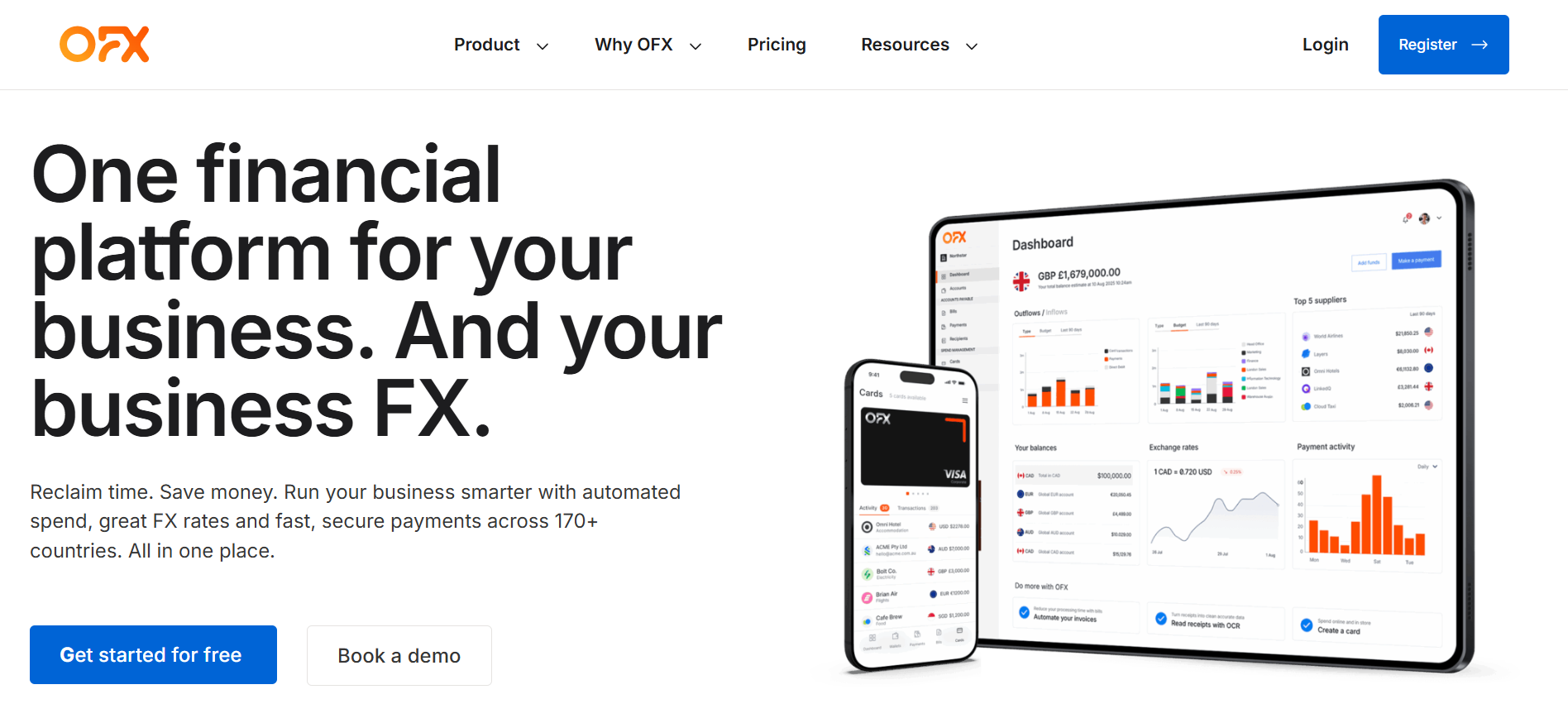
OFX business platform showing dashboard on tablet and phone, highlighting automated payments, FX rates, and spend tracking (Source: OFX’s homepage)

OFX positions itself as a global money transfer provider for businesses sending funds internationally at scale. It’s commonly used for recurring international payments and supplier settlements.

Features:

  • No fixed transfer fees on many routes: Avoid flat fees on larger international transfers.
  • Wide currency coverage: Send and receive multiple foreign currencies across global markets.
  • Business-focused accounts: Get access to tools designed for recurring international payments.

Cons:

  • Exchange rate competitiveness varies by volume and currency pair.
  • Settlement speed can be slower than expected on certain international transfers.

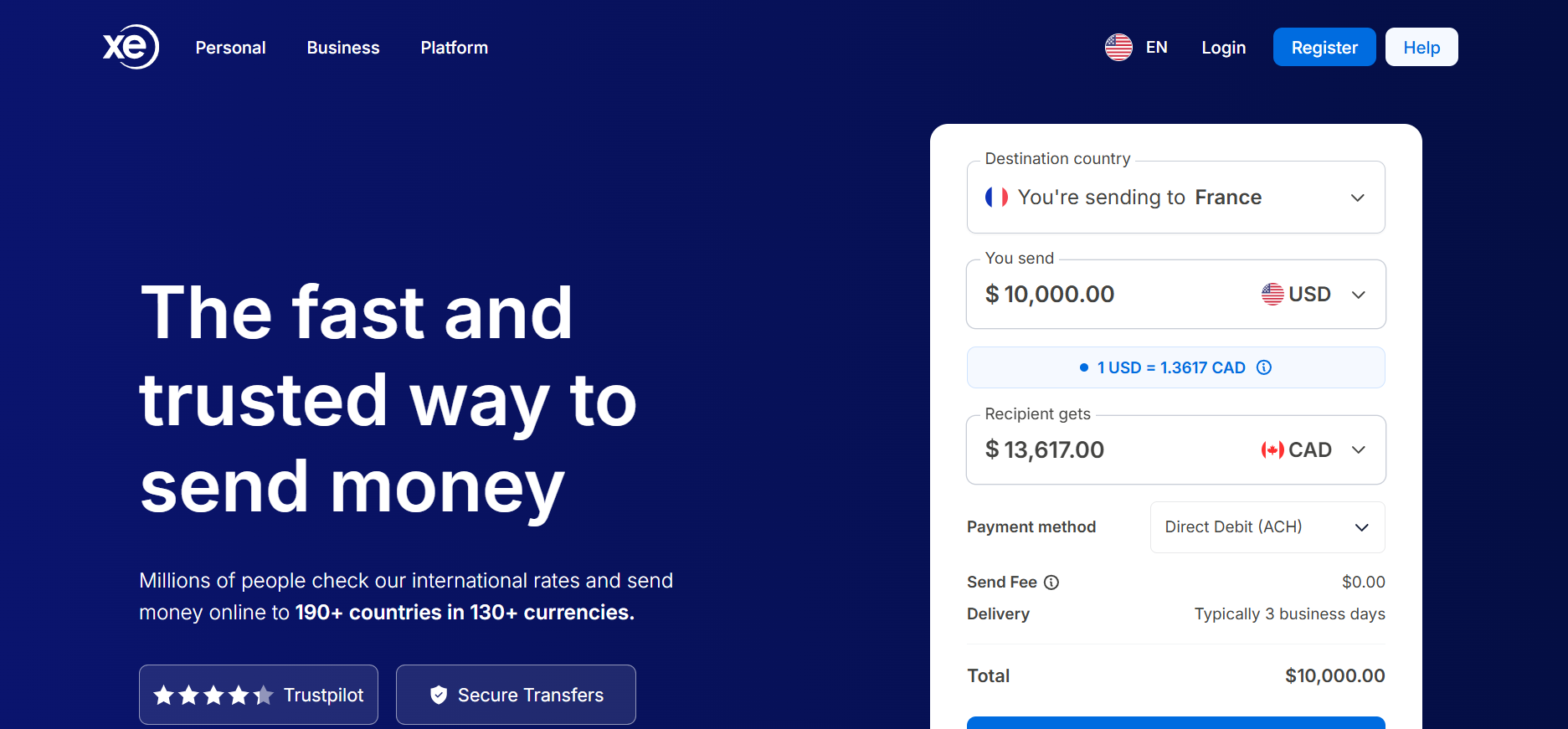
3. Xe Money Transfer

Xe is well known for its exchange rate data and offers international money transfers for businesses that prioritize brand familiarity and broad currency access.

Features:

  • Global currency reach: Send money in a wide range of different currencies.
  • Rate transparency: See exchange rates clearly before confirming transfers.
  • Established FX brand: Benefit from a long-standing presence in foreign exchange.

Cons:

  • FX spreads may be less competitive for high-value CAD–USD transfers.
  • Support is more transactional than relationship-driven for businesses.

4. PayPal Business

PayPal Open business platform homepage showing signup options, and a call to action for unified payments platform (Source: PayPal’s homepage)

PayPal Business is often used for receiving international payments rather than optimizing FX. It suits exporters who already invoice customers through PayPal and want simple access to global buyers.

Features:

  • Fast international payouts: Receive funds quickly from global customers.
  • Multiple payment methods: Accept credit cards and local payment options in many regions.
  • Easy integration: Plug into existing e-commerce and invoicing systems.

Cons:

  • Currency conversion fees and FX markups are high compared to FX specialists.
  • Limited control over exchange rates and settlement timing.

5. Your Canadian bank

Canadian flag flying in front of a modern glass building, symbolizing Canada’s financial and regulatory institutions

Most Canadian banks offer international wire transfers and foreign exchange services, making them the default option for many businesses, at least initially.

Features:

  • Direct account integration: Transfer straight from your Canadian bank account.
  • Familiar processes: Work within systems your finance team already knows.
  • In-branch availability: Access support in person if needed.

Cons:

  • Bank exchange rate markup and transaction fees are often the highest on the market.
  • International payments can be slow, opaque, and costly for frequent transfers.

KnightsbridgeFX vs. Wise: a side-by-side comparison

For Canadian businesses moving meaningful volumes, this side-by-side comparison highlights where each provider fits and where a Wise alternative like KnightsbridgeFX delivers more control, predictability, and long-term value.

What matters to your business KnightsbridgeFX Wise
Rates Consistently tight spreads with no hidden exchange rate markup—KnightsbridgeFX guarantees the best exchange rates for Canadian clients moving large sums Uses the mid-market rate but layers on transfer and conversion fees that scale with volume
Support Direct phone access to Canadian FX specialists who manage your transfers end-to-end Primarily ticket-based and self-serve support
Payment predictability Quoted rates and timelines are clear before you send, making cash flow planning easier Estimates vary by currency pair, payment method, and intermediary banks
Settlement speed Optimized for CAD–USD and major corridors with fewer delays Speed varies, especially on higher-value international transfers
Regulation FINTRAC-registered and purpose-built for Canadian businesses Regulated globally, but not Canada-first in execution
Security High-value transfer controls designed for six- and seven-figure transactions Secure for consumer and SMB use, less tailored for large volumes

Pricing breakdown: How much can businesses save by switching?

The real cost difference between Wise and a Wise alternative shows up as volumes grow. Small markups compound quickly in the following ways:

  • FX spread impact: A 0.3%–0.6% difference in exchange rate markup on CAD–USD transfers can translate into tens of thousands of dollars annually at higher volumes.
  • Flat vs. scalable pricing: Wise pricing stays largely flat as volume increases, while KnightsbridgeFX pricing improves as your transfer size grows.
  • Transfer fees: Per-transaction fees matter less than total FX cost, especially for importers and exporters moving money weekly.
  • Forecasting accuracy: Predictable rates reduce the need for pricing buffers and protect margins.

Businesses switching often cite savings as the deciding factor, reinforced by consistently strong KnightsbridgeFX reviews that highlight pricing transparency and real support. Over time, those incremental savings turn into a measurable competitive advantage.

How to choose the right Wise alternative for your business

The right Wise alternative depends on how you move money, how often you do it, and how much uncertainty you’re willing to absorb.

Consider your monthly FX volume

If you occasionally send or receive foreign currency, most providers appear similar. Once monthly transfers reach six figures, pricing structures diverge rapidly. Flat retail-style pricing becomes expensive, and small FX spreads turn into real dollars.

One of the most reliable ways to save money on currency exchange is choosing a provider that rewards higher volumes with better rates instead of locking you into consumer pricing.

Look at your core corridor

Most Canadian businesses rely heavily on CAD–USD flows. Some also work regularly with EUR or GBP. Your primary corridor should drive your decision. A provider that specializes in your most-used currency pair will offer tighter spreads, faster settlement, and more predictable payouts.

Generalist platforms that cover dozens of currencies often underperform where Canadian businesses actually transact the most.

Determine support needs

Support matters more as transfer size and urgency increase. If a delayed international payment could affect payroll, supplier relationships, or cash flow, ticket-based help desks create risk.

Look for direct phone access, named contacts, and clear escalation paths. Businesses switching providers often point to support quality as the most immediate operational upgrade.

Evaluate contract terms and transparency

Transparency protects you in the long term. Review how exchange rates are quoted, where markup appears, and whether pricing changes with volume. Avoid providers that rely on complex fee structures or vague rate disclosures. Clear terms make forecasting easier and prevent FX from becoming a hidden cost centre.

Why KnightsbridgeFX fits this framework

KnightsbridgeFX is designed around how Canadian businesses actually move money. You get custom business pricing that improves with volume, one-on-one phone support from Canadian FX specialists, and a fast setup that makes migration straightforward.

For companies treating foreign exchange as a strategic cost, not a convenience feature, KnightsbridgeFX consistently stands out as the practical, scalable alternative.

Get a customized FX rate quote for your business

If Wise no longer fits the way you move money, switching doesn’t have to be complicated. A strong Wise alternative should lower your FX costs, improve payment predictability, and give you direct access to people who understand Canadian banking and cross-border payments.

KnightsbridgeFX helps Canadian businesses reduce exchange rate markup, move large transfers securely, and get clear answers fast. You receive custom pricing based on your volume, one-on-one support from Canadian FX specialists, and a setup process designed for easy migration.

Speak with a KnightsbridgeFX specialist today to see your real exchange rate and how much you could save on your next transfer.

Wise vs. KnightsbridgeFX: Which Is Better for Canadians?

Cross-border payments shape your margins long before revenue hits your books. If you import inventory, pay overseas suppliers, or invoice clients in multiple currencies, small differences in exchange rates and fees compound quickly. That’s why many Canadian businesses compare Wise vs. KnightsbridgeFX when reviewing their foreign exchange setup.

Both platforms promise transparency and competitive pricing, but they serve business needs in very different ways. One prioritizes digital self-service and multi-currency accounts. The other focuses on high-value transfers, personalized support, and tighter spreads for Canadian companies making United States dollar (USD) and other major currency transactions.

This comparison breaks down how each option handles exchange rates, fees, speed, and support for B2B payments, so you can choose a solution that protects cash flow, simplifies accounting, and scales with your international operations.

Overview: Wise vs. KnightsbridgeFX at a glance

When comparing Wise vs. KnightsbridgeFX for business use, the key differences lie in how you transfer money, the amount you transfer, and the level of control you want over pricing and support. Let’s elaborate.

What Wise is best known for

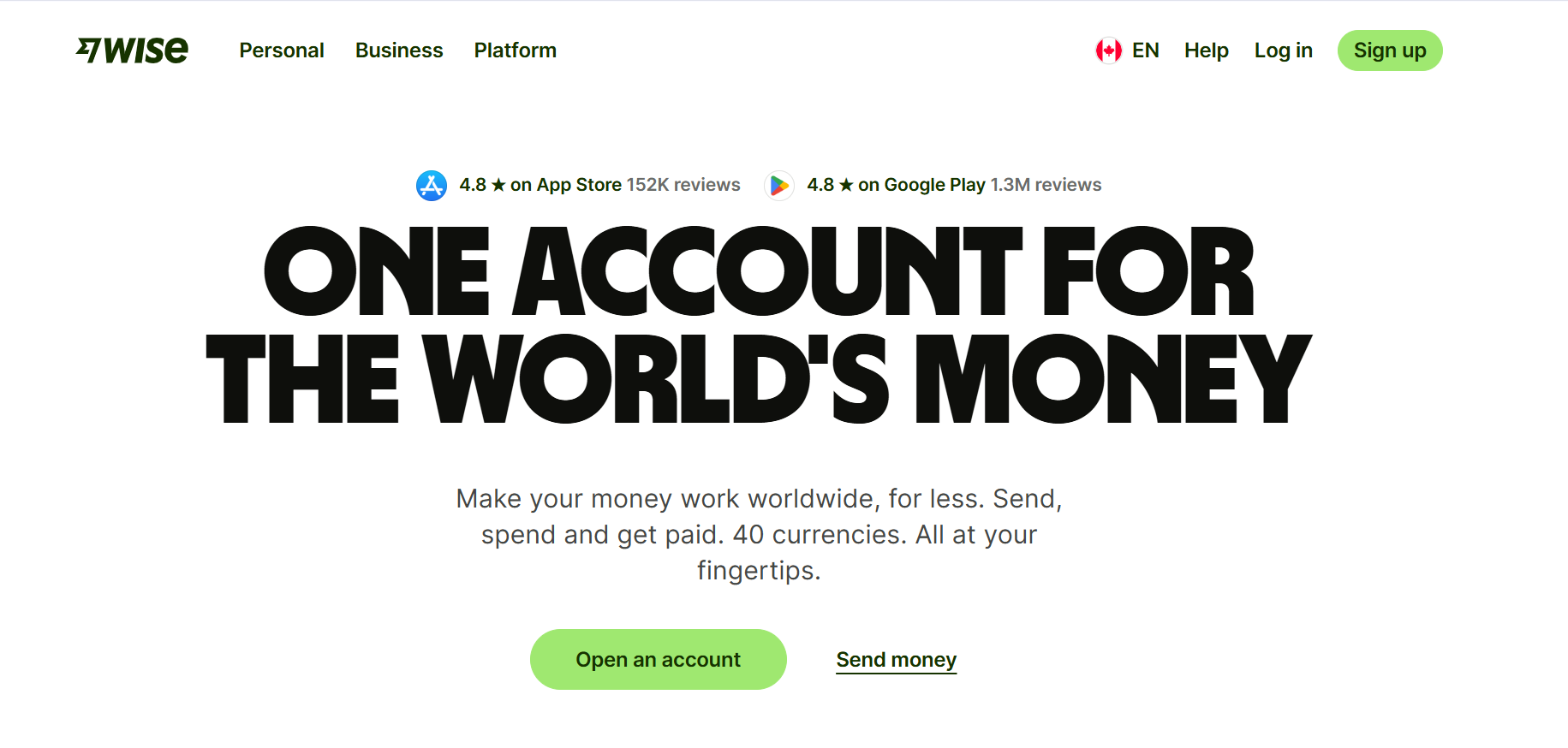
Wise homepage with headline “One account for the world's money” and buttons to open an account or send money (Source: Wise Homepage)

Wise, formerly TransferWise, built its reputation on digital-first international money transfers and transparent pricing. It suits businesses that prefer self-serve tools and frequent, lower-value payments across multiple currencies.

Wise stands out for:

  • A multi-currency account that lets you hold, send, and receive United States dollar (USD), euro (EUR), British pound (GBP), and other foreign currency balances
  • Online bank transfers using ACH, EFT, and local payment rails
  • Clear transfer fees shown before you send money
  • Showing a mid-market rate and then tacking a fee on top of the rate
  • Easy setup with minimal human interaction
  • Founded in Estonia with an initial focus on Europe

Wise offers efficiency for routine payments, especially when you pay international contractors or manage smaller invoices across several currencies.

What KnightsbridgeFX is best known for

KnightsbridgeFX homepage highlighting savings on exchange rates and a testimonial from a snowbird and property buyer

KnightsbridgeFX, a Canadian-based business, focuses on Canadian individuals and businesses that move larger amounts and want tighter control over exchange rates. It positions itself as a foreign exchange specialist rather than a general payment platform.

KnightsbridgeFX is known for:

  • Competitive exchange rates with lower spreads on large USD and other major currency conversions
  • No transfer fees on bank-to-bank foreign exchange transactions when using EFT
  • Dedicated account managers who quote live rates, help with time conversions, and assist in how to setup a wire transfer with additional handholding
  • Support for same-day or next-business-day settlements on United States dollar (USD) and Canadian dollar (CAD) transfers
  • Deep experience working with Canadian banks, importers, exporters, and corporate finance teams
  • Founded in Canada with Canadian support staff and intimate knowledge of the Canadian banking system and payment options
  • Specialized focus on snowbird currency exchange, real estate currency exchange, and small business currency exchange
  • Featured on “Dragon’s Den” in Canada and is one of Canada’s fastest-growing companies, per The Globe and Mail ranking in 2020

Knightsbridge Foreign Exchange appeals to companies where FX costs materially affect margins and predictability matters more than app-based convenience.

Key differences in business use cases

The Wise vs. KnightsbridgeFX decision becomes clearer when you map each service to real-world business needs.

Wise works best when you:

  • Send frequent international payments in local currency
  • Need a multi-currency account for operational flexibility
  • Prioritize automation over relationship-based support
  • Move smaller amounts where transfer fees matter less than speed

KnightsbridgeFX works best when you:

  • Exchange large amounts of USD or other foreign currency into CAD or vice versa
  • Want to reduce FX markup rather than pay visible transaction fees
  • Prefer phone or email support from a named FX specialist as needed
  • Need predictable pricing for supplier payments, inventory purchases, or cross-border settlements
  • Prefer a Canadian-based company with Canadian support staff and need assistance working with Canadian banks and infrastructure

FX pricing structures compared: Which saves businesses more?

Comparing Wise vs. KnightsbridgeFX reveals two distinct approaches to currency exchange pricing, particularly with increasing volumes.

How Wise pricing works

Wise uses the mid-market exchange rate and adds a visible markup plus a variable transfer fee. You see the total cost before you send funds, which supports budgeting and transparency.

Key pricing elements include:

  1. Mid-market exchange rate with a built-in percentage markup
  2. Variable transfer fees that scale with transaction size
  3. Additional currency conversion fees when moving between balances
  4. Separate costs for each international money transfer

For example, if your business sends USD to overseas suppliers multiple times per month, Wise charges a fee on every transaction. At lower volumes, this structure remains competitive. As amounts grow, cumulative fees increase quickly, even though the exchange rate itself stays close to market.

How KnightsbridgeFX pricing works

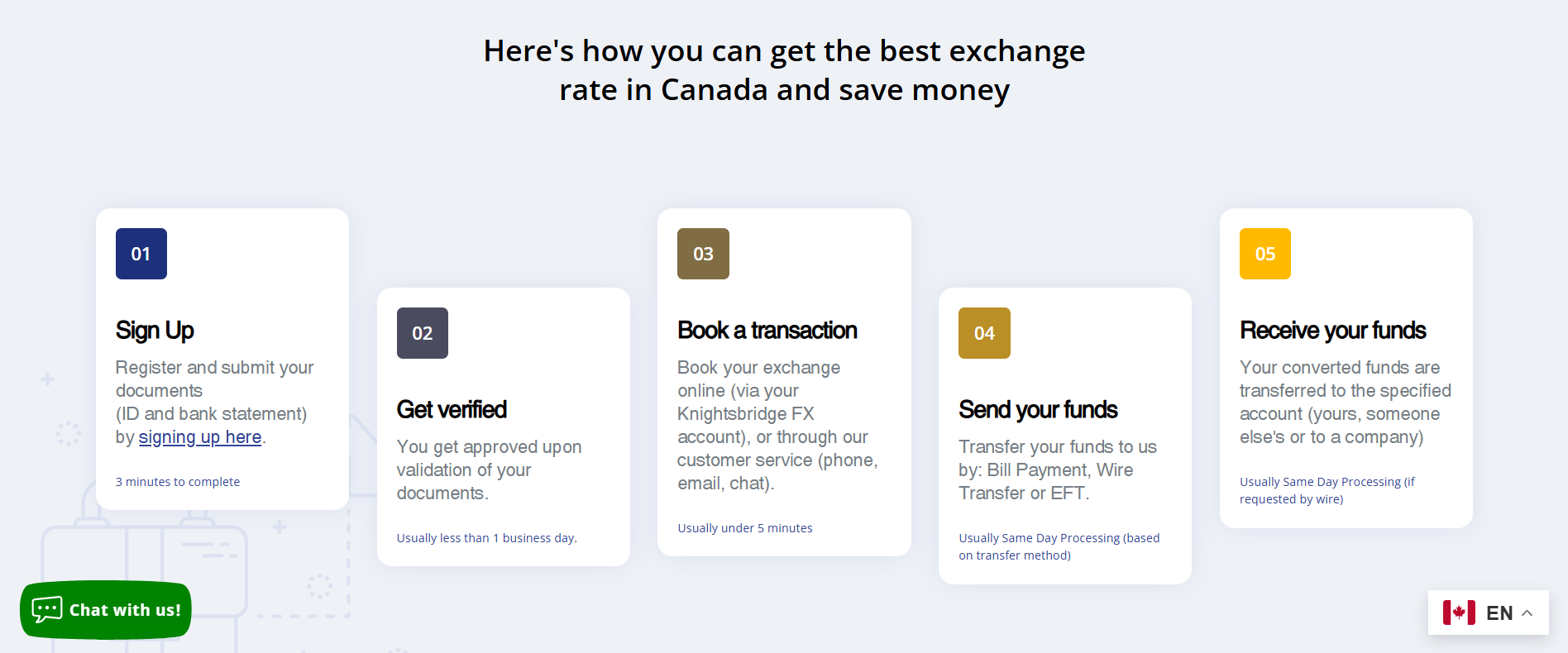
KnightsbridgeFX 5-step process: sign up, verify, book transaction, send funds, and receive converted funds

KnightsbridgeFX takes a spread-based approach that removes explicit transfer fees. Instead, savings come from tighter exchange rates, particularly for USD, EUR, and GBP conversions involving Canadian dollars.

KnightsbridgeFX pricing typically includes:

  1. Competitive exchange rates with reduced markup on higher volumes
  2. No wire transfer or bank transfer fees from KnightsbridgeFX
  3. Rate improvement as transaction size increases
  4. Live quotes provided by an account manager, and transactions can be booked via portal, phone, email, or live chat on the website

Consider an import business converting USD 500,000 into Canadian dollars for inventory payments. KnightsbridgeFX often delivers meaningful savings because the spread tightens as volume increases. You avoid per-transaction fees entirely, which materially lowers total FX costs over time.

What matters most for import/export teams

Import and export teams care less about fee visibility and more about total landed cost. In a Wise vs. KnightsbridgeFX scenario:

  • Wise works well for lower-volume, frequent payments with operational simplicity
  • KnightsbridgeFX performs better for high-volume currency conversion where pricing flexibility matters
  • FX markup matters more than transfer fees once transactions exceed five figures
  • Predictable spreads help finance teams forecast costs accurately

For businesses moving significant foreign currency through Canadian banks, KnightsbridgeFX usually saves more over the long term.

Transfer speed, reliability, and settlement times

Pricing means little if payments arrive late. Importers and exporters depend on reliable settlement timelines to release shipments, meet supplier terms, and avoid penalties. Comparing Wise vs. KnightsbridgeFX highlights clear operational differences in the following ways.

How Wise processes B2B transfers

Wise relies on automated payment rails and local clearing systems to move funds internationally. Once you initiate a transfer from your Wise account, the platform routes funds through local bank transfers such as ACH, EFT, or other domestic systems.

Operational characteristics include:

  • Automated processing with limited human intervention
  • Settlement times that vary by currency and destination
  • Transfers that typically complete within one to three business days
  • Limited ability to accelerate or intervene once a transfer starts

Wise performs well for standardized international transfers, but timelines can shift due to intermediary banks or local clearing delays. Support remains primarily digital, which works best when transfers go exactly as planned.

The KnightsbridgeFX settlement flow

KnightsbridgeFX uses a more hands-on settlement model built around Canadian bank transfers and direct coordination. Once you lock in an exchange rate, KnightsbridgeFX provides a clear settlement window and executes the conversion accordingly.

The process includes:

  1. Rate confirmation by phone, email, or online portal
  2. Clear funding instructions to your Canadian bank account
  3. Same-day or next-business-day settlement for major currencies
  4. Direct communication in case of market conditions or timing changes

KnightsbridgeFX stands out for its ability to provide exact timelines quickly. That reliability reduces operational friction for teams coordinating logistics, customs clearance, and bill payment schedules.

Why reliability matters

For import/export businesses, timing failures create real costs. Late payments delay shipments. Missed settlement windows trigger supplier penalties. Inconsistent delivery complicates cash flow planning.

Because Wise mostly offers speed for routine transfers, you often get limited control. On the other hand, KnightsbridgeFX delivers reliability through human oversight and dedicated support to reduce uncertainty during high-value transactions.

When cross-border payments support core operations, reliability often outweighs convenience. For Canadian businesses moving large sums across borders, KnightsbridgeFX aligns more closely with operational reality.

Support and risk management: Human vs. self-serve

The following is a clear divide between self-serve efficiency and relationship-driven FX management.

Wise support model

Wise runs on a digital-first support structure. The platform designs its workflows to minimise human involvement, which keeps costs down and enables scale across global markets.

Wise support typically includes:

  • Online help centres and FAQs for common issues
  • Email-based support for transfer questions or account verification
  • In-app notifications for payment status updates
  • Limited phone support, often reserved for specific issues

For routine international money transfers or smaller currency conversion needs, Wise offers enough guidance to stay operational. However, when delays occur or a large USD or EUR payment faces compliance checks, response times can stretch across business days.

KnightsbridgeFX support model

KnightsbridgeFX takes the opposite approach. It assigns a real FX specialist who understands your business, transaction history, and risk exposure. That human layer reduces uncertainty at every stage of the transfer.

KnightsbridgeFX support includes:

  • Direct phone and email access to a named account manager
  • Customer service agents and staff based in Canada who know the Canadian banking system
  • Live exchange rate quotes for large amount conversions
  • Proactive updates on settlement timelines
  • Immediate escalation when market volatility or banking issues arise

This model lowers operational risk for importers and exporters. If a USD payment must settle the same day to release goods, KnightsbridgeFX confirms timing up front. If market conditions shift, you receive guidance before you commit funds.

Why support matters in B2B FX

In B2B foreign exchange, mistakes scale quickly. A delayed wire transfer can stall inventory, while a pricing error can erase margin just as fast.

Wise reduces friction through automation but increases self-managed risk by placing timing, execution, and exception handling entirely on your internal team.

KnightsbridgeFX replaces automation with accountability. You work with a dedicated FX specialist who understands your transaction patterns and risk exposure, reducing uncertainty around high-value USD and foreign currency transfers.

That human oversight helps businesses save on currency exchange by avoiding rushed decisions, poorly timed conversions, and reactive transfers driven by operational pressure.

Platform experience and ease of use for business

Ease of use means different things depending on how your team operates. Comparing Wise vs. KnightsbridgeFX highlights two distinct approaches to daily FX workflows.

Wise platform strengths

Wise delivers a modern, intuitive interface designed for speed and independence. Businesses access everything through a single dashboard without speaking to anyone.

As a result, users enjoy the following advantages:

  1. A multi-currency account to hold USD, EUR, GBP, and other foreign currencies
  2. Fast setup and onboarding with minimal paperwork
  3. Automated bank transfers via ACH, EFT, and local payment rails
  4. Clear visibility into transfer fees, exchange rates, and settlement status

KnightsbridgeFX platform strengths

KnightsbridgeFX prioritises outcome over interface. The platform experience centres on execution quality rather than self-service features.

KnightsbridgeFX strengths include:

  1. Simple rate booking through phone, email, or website portal
  2. Clear funding instructions tied to Canadian bank accounts
  3. Minimal steps once rates lock in
  4. No need to manage multiple balances or internal wallets

This approach reduces cognitive load for teams handling large FX transactions. Instead of navigating dashboards, you focus on timing, pricing, and settlement certainty. That simplicity supports businesses looking to save on currency exchange without adding operational complexity.

Which is better for B2B workflows?

The right choice depends on the transaction profile in the following ways:

Business workflow factor Wise KnightsbridgeFX
Team structure Decentralised teams managing payments independently Finance-led teams with central FX control
Typical transaction size Low-value, frequent international transfers High-value USD and foreign currency conversions
FX decision-making Self-serve, platform-driven Guided by an FX specialist
Primary optimisation Convenience and automation Pricing outcomes and margin protection
Best use case Routine operational payments Strategic FX for imports, exports, and supplier payments

For Canadian businesses focused on the best way to send money Canada-wide while protecting margins, KnightsbridgeFX aligns better with B2B workflows where FX decisions carry weight.

Security, compliance, and trust factors for Canadian businesses

When you move large sums across borders, trust carries as much weight as pricing. Importers and exporters, especially those that import or export luxury goods, face heightened scrutiny, tighter timelines, and greater downside risk if payments fail.

Regulatory status for Wise

Wise operates as a regulated financial services provider in multiple jurisdictions. In Canada, Wise registers with the Financial Transactions and Reports Analysis Centre of Canada (FINTRAC) as a money services business and follows local anti-money laundering and know-your-customer requirements.

From a compliance standpoint, Wise provides:

  • FINTRAC registration for Canadian operations
  • Safeguarded client funds held separately from operating capital
  • Automated compliance checks on international transfers
  • Standard reporting aligned with global financial institutions

However, compliance interactions remain largely automated. If a transfer triggers enhanced review, resolution can take multiple business days with limited escalation options.

KnightsbridgeFX regulatory status

KnightsbridgeFX operates as a Canadian foreign exchange specialist and also registers with FINTRAC. Its compliance model pairs regulatory oversight with human review, which reduces friction for complex or high-value transactions.

KnightsbridgeFX compliance strengths include:

  • FINTRAC registration and Canadian regulatory alignment
  • Client funds are held separately from operating accounts
  • Manual review of large USD, EUR, and GBP conversions
  • Clear audit trails for bank transfers and currency conversion
  • Direct communication during compliance checks

This structure benefits businesses moving large amounts or operating in regulated industries. For companies that import and export goods, documentation accuracy and payment traceability matter. KnightsbridgeFX reduces risk by addressing issues in real time rather than routing them through ticket systems.

Why security and compliance matter for import/export companies

In B2B foreign exchange, payment failure carries real operational consequences. A delayed or rejected transfer can stop goods at the border, strain supplier relationships, or trigger compliance reviews at Canadian banks.

The difference between Wise and KnightsbridgeFX comes down to how issues get resolved. Wise relies on compliant, automated systems that work well at scale but offer limited human intervention when something goes wrong. KnightsbridgeFX pairs regulatory compliance with direct specialist oversight, which helps resolve questions before they become delays.

Strong compliance shortens settlement timelines, reduces payment reversals, and creates clear documentation for audits and disputes. For Canadian businesses managing high-value cross-border payments, that consistency builds trust where it matters most.

Which FX is right for your business?

The right FX partner depends on how you move money, how much you move, and how much risk you can tolerate.

When Wise is the right choice

Wise fits businesses that value speed, autonomy, and global reach over customised pricing.

Therefore, choose Wise if you:

  • Send frequent international payments in smaller amounts
  • Use a multi-currency account to manage operational cash flow
  • Accept visible transfer fees for pricing transparency
  • Prefer digital self-service over relationship-based support

When KnightsbridgeFX is the right choice

KnightsbridgeFX suits businesses where FX costs affect profitability and timing matters.

Choose KnightsbridgeFX if you:

  • Prefer to work with a Canadian company with Canadian staff and expertise with Canadians and Canadian banks
  • Convert large amounts of USD or foreign currency into Canadian dollars
  • Want to save on currency exchange through tighter spreads
  • Need predictable settlement timelines
  • Import or export luxury goods or high-value inventory
  • Prefer direct access to an FX specialist

How to evaluate your next transfer

Before your next transaction, run through this checklist:

  1. FX margin: How wide is the markup on your currency conversion?
  2. Fees: Do transfer fees compound as volume increases?
  3. Support: Can you reach a real person when timing matters?
  4. Timeline: Do you know the exact settlement date up front?
  5. Risks: Who manages delays, compliance reviews, or errors?
  6. Volume needs: Does pricing improve as amounts increase?

If FX plays a strategic role in your business, compare total landed cost, not just headline rates.

Get a quote from KnightsbridgeFX to compare your landed FX cost in minutes and see how much you could save.

FX Monthly Update | January 2026

Economic Outlook and Summary

December delivered its usual mix of end-of-year central bank meetings to a shrinking pool of interested observers, as many traders and desks had closed their books for the year. The European Central Bank left rates unchanged and indicated rates would remain unchanged for the foreseeable future. Across the English Channel, the Bank of England trimmed its benchmark rate by 25 bps to 3.75%, and despite four policymakers preferring to leave rates unchanged, the outlook was for another rate cut by March. The Bank of Japan raised its key rate from 0.50% to 0.75%, its highest level in 30 years. The Bank of Canada left rates unchanged, and the Fed cut by 25 bps, as expected.

The first week of January has started slowly, as many traders are still on vacation.


The USD and Federal Reserve

The U.S. dollar traded defensively throughout December, with selling pressure stemming from the Fed rate cut and exacerbated by expectations for further rate cuts in 2026. Divergent monetary policies from the Bank of Japan, ECB, and Bank of Canada also weighed on the greenback. The greenback recouped some losses after the release of the FOMC minutes on December 30 showed a divided Committee, which suggests policymakers are in no hurry to cut rates.

There is a lot of key data ahead of the January 28 FOMC meeting. Unfortunately, the ongoing fallout from questionable or incomplete numbers due to the October government shutdown suggests a degree of U.S. dollar volatility, despite low odds of a rate cut on that date.


The Canadian Dollar and Bank of Canada

The Canadian dollar finished December on a firm footing, posting a 1.83% monthly gain and ending the year up 4.39%. The Bank of Canada left its benchmark rate unchanged at 2.25%, a widely anticipated decision. The December 23 Summary of Deliberations revealed policymakers were encouraged by upward revisions to GDP for the previous three years, but remained uneasy about uneven underlying momentum, particularly the ongoing weakness in business investment.

Looking ahead to January, the Canadian dollar is likely to remain tethered to broad U.S. dollar sentiment rather than domestic fundamentals. USDCAD has edged higher since Boxing Day in thin holiday trading but remains firmly trapped within the well-defined 1.3600–1.4000 range that has capped price action since July. With no clear domestic catalyst on the horizon and liquidity normalizing only gradually, price action in January is expected to remain range-driven, with rallies fading near the top of the band and dips attracting support toward the lower end.


Oil Prices

WTI oil prices drifted lower into mid-December as concerns over U.S. interest rates and an expected crude surplus in the first half of 2026 weighed on sentiment. Those worries were quickly overtaken by political shockwaves. Despite the headline drama, WTI prices have remained stubbornly rangebound. Looking into January, upside momentum is likely to be capped by ample inventories while downside risks are cushioned by geopolitical uncertainty, leaving prices biased toward a 55.00–60.00 trading range.

Canadian Dollar Update – Canadian dollar gains accelerate


  • Divergent Fed and BoC monetary policy outlooks lifting Loonie.
  • Lots of US data today, although the quality is questionable.
  • US dollar opens with losses across the board.


Merry Christmas and Happy New Year from Knightsbridge Foreign Exchange. This is the final commentary update of 2025, and will resume on January 5, 2026.  We are still open for currency exchange daily.

USDCAD open: 1.3702, overnight range 1.3702-1.3755, close 1.3747, WTI 58.08, Gold 4484.09

The Canadian dollar is grinding higher on the back of the soft US dollar.  Canada Raw Materials Price and Industrial Price indexes are due today and October GDP is on tap tomorrow.

The US is set to publish current account figures alongside Durable Goods Orders, Q3 GDP, Capacity Utilization, Industrial Production, and Q3 PCE Prices. Any insight drawn from October data should be treated with caution, as the collection process was compromised to the point of near irrelevance. With the Fed already having made its move and desks thinning out ahead of year end, the market appetite for parsing noisy data is limited.

Asian equity markets finished the session higher, led by a 0.64 percent gain in Japan’s Topix, a 0.43 percent rise in Hong Kong’s Hang Seng, and a 0.91 percent advance in Australia’s ASX 200.

By 7:10 am, European markets were struggling for direction. Germany’s DAX was up 0.12%, France’s CAC-40 was down 0.20%, and the UK’s FTSE 100 was flat. S&P 500 futures were little changed, the US Dollar Index was softer at 97.89, and the US 10 year Treasury yield was holding at 4.146%.

EURUSD climbed to 1.1801 from 1.1756 to 1.1801 due to broad US dollar weakness. ECB board member Isabel Schnabel reiterated that euro area rates could still move higher, though she made it clear that such a shift is not imminent.

GBPUSD rallied in a 1.3459-1.3515 range, driven by broad US dollar selling. Sterling continues to draw support from a relatively firm Bank of England stance on rates alongside a more accommodative tone from the Fed.

USDJPY traded lower in a 157.08-155.66 range as concerns resurfaced that Japanese authorities may exploit thin year end liquidity to intervene. Officials continue to warn about excessive and one-sided moves.

AUDUSD traded in a 0.6655-0.6698 band and was holding near the top of that move in New York, underpinned by general US dollar weakness. Additional support came from the minutes of the December 9 RBA meeting, which were interpreted as hawkish given the discussion around the need for higher rates to maintain economic balance.


Canadian Dollar Update – Canadian dollar steady

  • Bank Of Japan hikes rates to 0.75%
  • Global equity markets are ending the week quietly
  • US dollar opened with small gains after quiet session


USDCAD open: 1.3794, overnight range 1.3770-1.3798, close 1.3780, WTI 56.02, Gold 4328.22

The Canadian dollar is adrift in a dull holiday market. The only excitement today may come from the release of Retail Sales, and New Housing Prices. Retail Sales, ex-autos are expected to be unchanged compared to the September result and should be of little interest to traders.

WTI oil prices see-sawed in a 55.62-56.25 range. Trump’s ongoing feud with Venezuela is providing a bit of support for prices however the topside is limited by oversupply fears.

US inflation appeared to cool in November, with headline CPI printing at 2.7% against expectations of 3.1%, while core CPI rose 2.6% versus a 3.0% forecast. However, since October data was missing entirely and the November figures were incomplete, markets are no better informed about the true state of US inflation than they were a month ago.

Asian equity markets wrapped up the week on a positive note. Japan’s Topix advanced 0.80%, Hong Kong’s Hang Seng climbed 0.76%, and Australia’s ASX 200 rose 0.39%.

As of 7:05 am, European equity markets were hovering around flat, while S&P 500 futures were up 0.12%. The US Dollar Index is  98.70,and  the US 10 year Treasury yield stood at 4.195%.

EURUSD traded in a 1.1704 to 1.1763 range. The ECB left rates unchanged yesterday, as expected but raised both growth and inflation projections, prompting speculation among analysts that the easing cycle may be over.

GBPUSD traded in a narrow 1.3363 to 1.3388 range and went nowhere, with markets largely ignoring a modest improvement in GfK consumer confidence to -17 from -19 and unchanged headline Retail sales numbers.  Yesterday, the Bank of England cut rates to 3.75% from 4.0%. The outlook for further easing remains murky, with policymakers clearly divided.

USDJPY traded in a 155.50 to 157.40 range and surged following the Bank of Japan decision. The BoJ raised its benchmark rate to 0.75% as expected, but the accompanying statement struck a dovish tone. Officials projected that consumer inflation will fall below 2.0% next year, leading analysts to push expectations for the next rate hike out by at least six months. Notably, the statement made no reference to currency weakness.

AUDUSD traded in a 0.6600 to 0.6623 range and drifted quietly as traders looked ahead to the holidays. AUDUSD continues to find support from this week’s consumer inflation expectations data.


Canadian Dollar Update – Canadian dollar ticking lower

  • US CPI data ahead
  • Bank of England cuts rates in 5-4 decision
  • US dollar opens mixed after quiet overnight session


USDCAD open: 1.3779, overnight range 1.3768-1.3789, close 1.3787, WTI 55.84, Gold 4325.32

The Canadian dollar is lost and looking for direction as it bounces between support and resistance levels. FX markets have wound down for the holidays and domestic economic data has taken a back seat to US numbers and what they mean for future Fed decisions.

WTI oil prices are choppy in a 55.74-56.85 range due to shifting geopolitical tensions and Opec’s earlier decision to boost production. The cartel may be leaving existing quotas unchanged for Q 1 2026, but the damage has been done.

Weekly jobless claims, the Philadelphia Fed Manufacturing Survey, and the Consumer Price Index are all due this morning and may generate a brief burst of activity when the data hits the screens, but any reaction is likely to fade quickly. The FOMC decision is behind us and markets are effectively marking time as traders wind down ahead of the Christmas holidays.

Asian equity markets finished broadly flat, with Japan’s Topix down 0.37% ahead of tomorrow’s Bank of Japan meeting, while Australia’s ASX 200 and Hong Kong’s Hang Seng ended little changed.

As of 7:40 am,  the UK FTSE 100 is flat, while France’s CAC 40 is up .015% and the German DAX has gained 0.28%.  S&P 500 futures are up 0.40%, the US Dollar Index is 98.52, and  the US 10-year Treasury yield sits at 4.142%.

EURUSD traded in a 1.1717–1.1750 range as markets stayed sidelined ahead of the ECB policy decision today. No change in interest rates is expected, leaving the focus on updated forecasts, with some analysts anticipating a downgrade to the 2026 CPI projection from 1.7%.

GBPUSD moved within a 1.3341–1.3382 range ahead of the Bank of England decision before jumping to 1.3394 from 1.3354 after the BoE delivered a 25 bp rate cut to 3.75%. The vote split was 5–4, with four policymakers preferring to leave rates unchanged.

USDJPY traded near the top of its 155.48–155.98 range, supported by broad US dollar strength. The Bank of Japan is expected to hike rates to 0.75% tomorrow, though policymakers continue to grapple with a softer-than-expected economy after Q3 GDP rose just 0.6% q/q, raising concerns that tighter policy could add further strain.

AUDUSD drifted in a 0.6593–0.6613 range, rebounding from the session low after consumer inflation expectations rose 0.2% to 4.7% from 4.5% in November. The move was largely anticipated after the Australian government raised its inflation outlook earlier in the week.


Canadian Dollar Update – Canadian dollar gives back some gains

  • Oil rallies on Trump’s Venezuela blockade
  • UK inflation numbers sink GBPUSD
  • US dollar recoups some losses after mixed NFP data.


USDCAD open: 1.3783, overnight range 1.3753-1.3796, close 1.3755, WTI 56.45, Gold 4317.80

The Canadian dollar turned tail after yesterday’s US nonfarm payrolls numbers failed to confirm the need for aggressive Fed rate cuts. However, the losses are just a correction unless USDCAD breaks above 1.3810.

WTI oil spiked from yesterday’s low of 54.87 and hit 56.58 overnight before easing to 56.28 in NY. API reported a drawdown of 9.3 million barrels, which far exceeded expectations for a drawdown of 2.2 million barrels. The news was overshadowed after Trump ordered a blockade of all sanctioned oil tankers in Venezuela.

The US dollar’s decline came to an abrupt stop after the combined October and November nonfarm payrolls release failed to deliver a clear signal of labour market deterioration. Rather than confirming accelerating weakness, the report produced patchy and unreliable results, reflecting a reduced survey response rate and elevated data distortion. As a result, it reinforced existing convictions on both sides of the rate debate without shifting expectations in any meaningful way.

The greenback extended gains in the following session, supported by a sharp rise in geopolitical tension driven by Trump’s threat of additional sanctions on Russia should Putin reject the latest ceasefire proposal.

Asian bourses closed without a clear direction, with gains in Hong Kong offset by weakness in Australia and flat trading in Japan.

As of 7:45,  the UK FTSE 100 is up 1.63%,  while the French CAC 40  and German DAX are flat. US equity futures are up 0.35%, Treasury yields are 4.17% and the dollar index is 98.55.

EURUSD traded erratically in a 1.1704–1.1753 range. The euro weakened initially after the US employment data and extended losses following another disappointing German Ifo survey. The business climate index slipped to 87.6 in December, highlighting rising pessimism among German firms about growth prospects into the first half of 2026.

GBPUSD in a 1.3312–1.3427 range sold off sharply after a softer-than-expected UK inflation report strengthened the case for a 25 bp Bank of England rate cut. Headline CPI declined 0.2% m/m against expectations for no change, while core inflation eased to 3.2% y/y. Despite the pullback, price action above 1.3290 suggests the move remains corrective rather than trend-defining.

USDJPY rallied in a 154.52–155.60 band after the muddled US payrolls report clouded the Fed rate outlook. Additional support came from comments by Japanese Prime Minister Takaichi, who argued for boosting economic capacity through targeted fiscal stimulus. Markets continue to anticipate a Bank of Japan rate hike at the end of the week.

AUDUSD dipped in a 0.6612–0.6636 range  amid renewed US dollar demand as expectations for near-term Fed easing were pared back. Losses were partially cushioned by growing speculation that the Reserve Bank of Australia could move toward a rate hike as early as February.

There are no US or Canadian economic reports of note on tap today.


Canadian Dollar Update – Canadian dollar in park

  • Traders looking ahead to major central bank meetings (BoE, ECB and BoJ)
  • US NFP data for October and November due tomorrow
  • US dollar inches lower in quiet overnight session


USDCAD open: 1.3775, overnight range 1.3758-1.3777, close 1.3774, WTI 57.12, Gold 4337.72.

The Canadian dollar is trading sideways in a narrow range, with traders awaiting todays Canadian inflation report and tomorrow’s US employment data.

Canada CPI is expected to have risen to 2.4% from 2.2% y/y but it isn’t a big deal as that headline number is well-within the BoC inflation range of 1-3%.  Tuesday’s US data carries more weight for USDCAD direction.

Fed Chair Powell managed to increase the importance of the twin October-November NFP reports last week when he said, “We think that there is an overstatement in these numbers.” Apparently, Fed staffers estimate that the economy has been shedding about 60,000 jobs each month.

WTI  oil sank in a 57.37-58.19 band because of concerns that a Ukraine Russian peace deal would see additional Russian oil supplies as sanctions get repealed.

A busy week of central bank decisions lies ahead. The Bank of England is expected to kick things off on Thursday with a widely anticipated 25 bp rate cut to 3.75%. The ECB follows, where President Lagarde is likely to justify keeping rates unchanged. The Bank of Japan is also expected to raise rates, lifting its benchmark to 0.75%. Policy decisions from Sweden’s Riksbank and Norway’s Norges Bank round out the schedule.

Asian equity markets were mixed. Japan’s Topix edged 0.22% higher, while Hong Kong’s Hang Seng fell 1.34% and Australia’s ASX 200 declined 0.72%, pressured by a weak Wall Street close and disappointing data from China.

As of 7:30 am, the CAC 40 had gained 1.13%,  the FTSE 100 was up 0.92%,  the DAX rose 0.45% higher and S&P 500 futures were up 0.49%. The US Dollar Index was holding at 98.24 and the US 10-year Treasury yield was 4.161%, and gold.

EURUSD traded in a 1.1727-1.1756 range and was sitting near the top of that band in subdued conditions. Limited news flow and the wait for US labour data kept activity light, though the euro found modest support after industrial production rose 0.8% in October, beating expectations and improving from September’s 0.2% gain.

GBPUSD traded in a 1.3355-1.3593 range as markets positioned for a likely 25 bp Bank of England rate cut to 3.75%. Sterling could still react positively if positioning proves extreme, with CFTC data showing short positions near decade highs. A less dovish message than expected could trigger an aggressive short-covering move.

USDJPY traded in a 154.85-155.99 range but slipped toward the lower end after Tankan survey results pushed expectations for a Bank of Japan rate hike this week above 90%. Governor Kazuo Ueda has reinforced those expectations by highlighting the importance of upcoming wage negotiations.

AUDUSD traded in a 0.6639-0.6656 range and moved sideways through the session. Broad US dollar softness offered some support, though gains were limited by weaker-than-expected Chinese economic data.

There are no notable US reports today.